

Surfcasting rod: 3.90, 4.20 or 4.50 m? A buying guide for Mediterranean and Gulf beaches
Guide contents
You are standing in a tackle shop holding two rods at a similar price. One is 4.20 m, the other 4.50 m. Someone tells you: "Take the longer one, it will cast further and lift the line over the waves." Another voice says: "The shorter one is more comfortable, especially if you are still learning." Both describe part of the picture, but which one suits your beach, your sinker and your casting style?
Choosing a surf rod does not start with the longest rod you can afford. It starts with the lightest set-up you can control and that still gets the bait to the spot you want. 3.90 m may suit you better than a longer rod, you may genuinely benefit from 4.50 m, and 4.20 m sits between them as a starting point for comparison, not a ready answer for every angler.
In this guide we look at the practical differences between the three lengths and how they relate to waves, casting and fatigue. Then we apply the idea to Alexandria and Mediterranean beaches, and to the sandy flats of Kuwait and the Gulf, without promising casting distances or a size that suits every condition.
1. Before comparing: what do we mean by surfcasting?
Here we mean fishing from the beach with bait and a sinker, using a rod that sends the rig to a suitable distance and lets you monitor it, usually resting on a sand spike or fixed holder. We are not talking about a jigging rod for boats, nor a rod for casting artificial lures that you cast and retrieve over and over; each method has its own requirements.
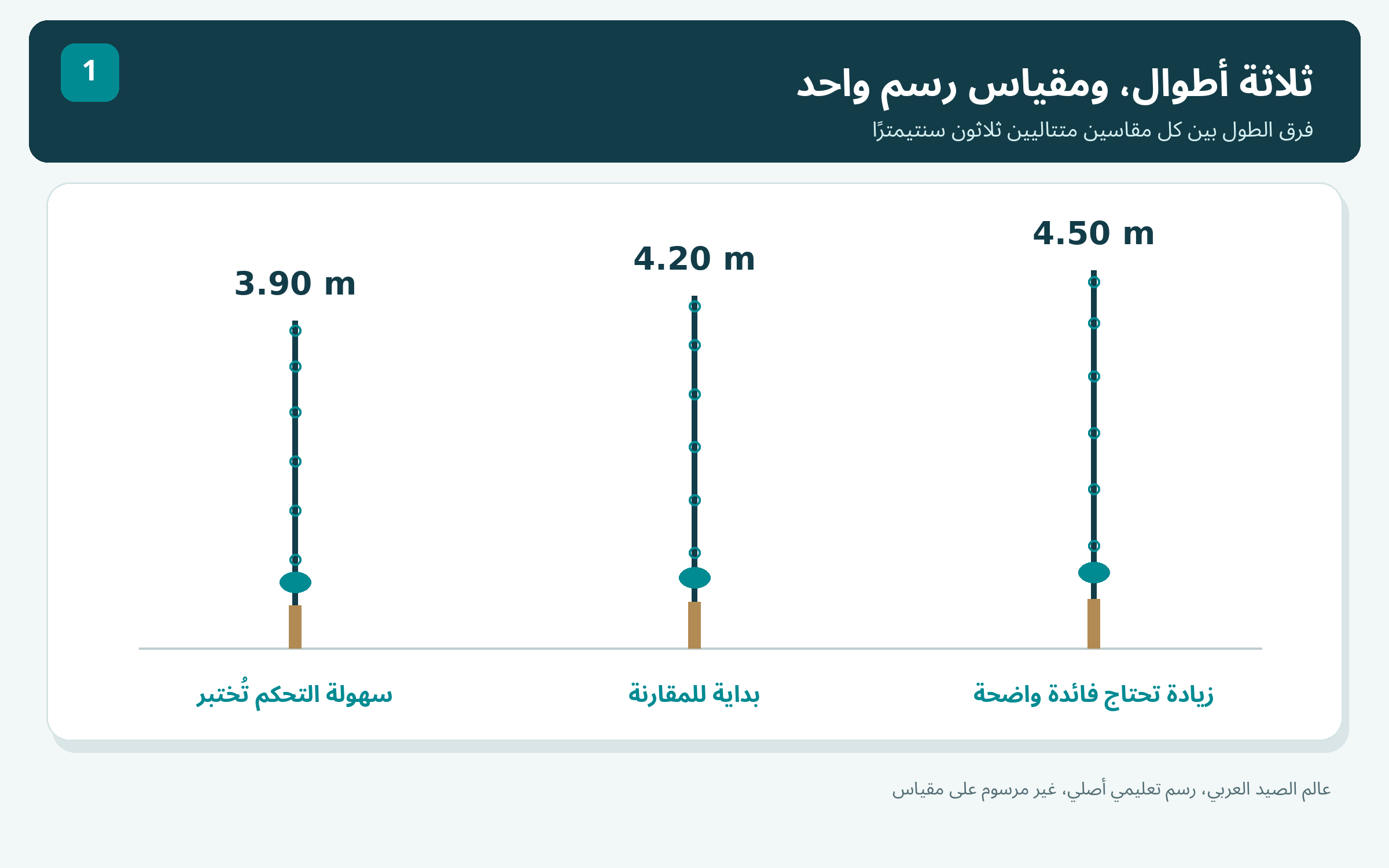
3.90, 4.20 and 4.50 m are neighbouring options inside this category. The gap between two consecutive sizes is only 30 centimetres, but it can change the feel of the balance, the path of the tip, and how you carry and transport the rod. Even so, length alone tells you nothing about a rod's weight, stiffness or build quality.
The right question is not "which size is strongest?" but "which model suits the load I cast, the place I fish, and the movement I can repeat?"
2. Quick comparison of the three lengths
This is a general comparison assuming similar design, material and rating. The verdict may change when you compare a heavy budget rod with a higher-quality one.
| Length | When is it worth trying? | What to check before buying |
|---|---|---|
| 3.90 m | When control and ease of movement are priorities and your cast reaches the target zone | Tip height on the holder, handle fit, and load rating |
| 4.20 m | As a comparison point for anglers who want a balance between a beach-suitable length and ease of use | Actual weight and balance; not every rod of this length is comfortable |
| 4.50 m | When you need more tip height or can benefit from extra length when casting | Your ability to accelerate and load the rod smoothly, and the space available behind you |
There is no documented figure making 4.20 m right for "90% of anglers", and no binding rule that says short rods are for short anglers and long rods for tall ones. Body height and arm reach help, but reel position, the distance between your hands and your technique can change the result completely.
3. 3.90 m: control before distance
The possible advantage of this length is that the tip's movement stays closer to you, and you may find it easier to guide the rod and finish the cast, especially when moving up from a shorter rod. With similar specifications, there may also be less mass to handle during the stroke compared with a longer version in the same series.
But it is not automatically "light and easy" just because 3.90 is printed on it. There are short rods that are heavy or very stiff, and longer ones that are lighter and better balanced. Hold the model with the reel you will actually use, not the rod on its own, because what you feel in the shoulder depends on the whole set-up.
When is it a sensible choice?
If the bait needs to reach a near or medium edge, and you do not need to lift the line above a wide band of surf, this length may give you what you need without extra length you will not use. It is also worth trying if you struggle to time the cast with a longer rod.
Its possible limitation appears when you need a higher tip, or more working space to steer the line away from nearby waves. That is not a rule saying 3.90 fails in a moving sea; the holder height, rod angle, distance to the water and wave shape all enter the calculation.
A useful test: can you repeat the cast in one direction and stop the movement in balance, without throwing your body around violently? If so, and the load is suitable, you are closer to a choice you can learn and build on.
4. 4.20 m: a good starting point for comparison
If you have no specific need favouring either end, start by comparing 4.20 m models. This is a practical suggestion to narrow the options, not a verdict that this is the best or most widespread length in Egypt without data to support it.
Its length gives good working room from the beach, with a smaller step up than jumping straight to 4.50 m. It can be comfortable for varied use with bait and sinker, provided the casting rating, handle and bend profile suit you.
But the word "all-rounder" can mislead you. A 4.20 m rod rated for light loads does not become a heavy rod just because the length is convenient. And a very stiff one can tire a beginner even if the length matches a more flexible rod.
Before you pay, ask: is the weight listed? What is the model code? Is the big number on the rod a maximum or a range of loads? Does the reel seat grip firmly and leave the lower hand a comfortable place? The answers matter more than the popular name of the length.
5. 4.50 m: when does the extra length really help?
The extra length may help a skilled angler use a longer tip path. But it also increases the control and timing you need, and may increase the torque felt in your hands depending on how the mass is distributed.
If the rod slows you down or you have to cut the stroke short, you may cast a better and more consistent distance with a shorter version. That is why no honest table says that going from 4.20 to 4.50 adds a fixed number of metres.
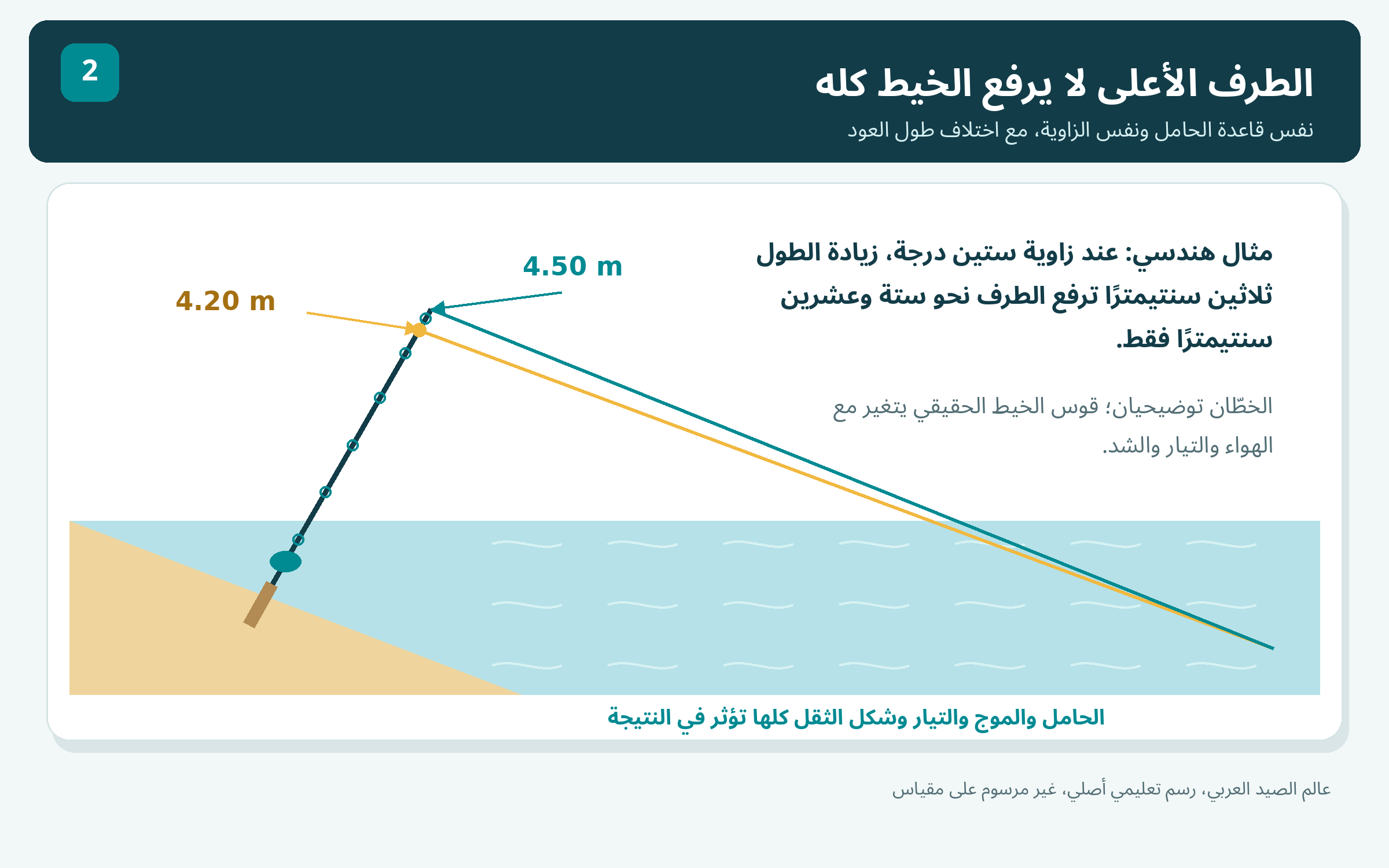
The second benefit is tip height on the holder. With the base position and angle unchanged, the extra length raises the tip and may reduce the contact of part of the line with nearby waves. But it does not lift all the line out of the sea, and it does not guarantee the sinker will hold.
Do you need to be tall and strong?
Strength and range of movement help, but they do not replace timing and balance. An average-height angler may handle a 4.50 m rod that suits him, while a taller angler may struggle with one that fits his handle or style less well.
Likewise, do not choose this length because you plan to fish during a storm. Whether it is safe to stand on the beach, and the state of the sea, come before choosing a rod. A longer rod is a tool for control in conditions that are suitable for fishing; it is not a licence to go down to the water in dangerous surf.
6. Casting distance: why length does not settle it
A cast begins by transferring movement energy to the rod and rig, then the line leaves evenly. If the load does not match the rod, or the line leaves with a lot of friction, or the tip oscillates because of poor timing, length alone will not solve the problem.
Check the full load, the line diameter and condition, the spool fill level according to the reel's instructions, and the condition of the guides and knot. A large, loosely held bait can increase air resistance or break up during the cast; then a longer cast is not a useful result at all.
A fair comparison uses similar tackle and similar conditions, and several controlled casts rather than a single best one. Record direction, consistency and effort next to distance, and do not treat reel turns as an exact measure of metres; the amount retrieved changes with spool fill and line tension.
Side casts and OTG ("off the ground") casting need space, training and suitable tackle. Do not transfer them to a crowded beach just because you bought a long rod. As a beginner, learn a controlled overhead movement with an experienced person, and make sure the path of the rig and the area behind you are clear of people and obstacles.
7. More important than length: casting weight, action and power
Casting weight is not the weight of the fish
If you see a range such as 100–200 g, it refers to casting loads as defined by the manufacturer, not to the weight of the fish the rod can land. If a single number is given, read the model description to learn what it means instead of assuming it is the ideal weight for every cast.
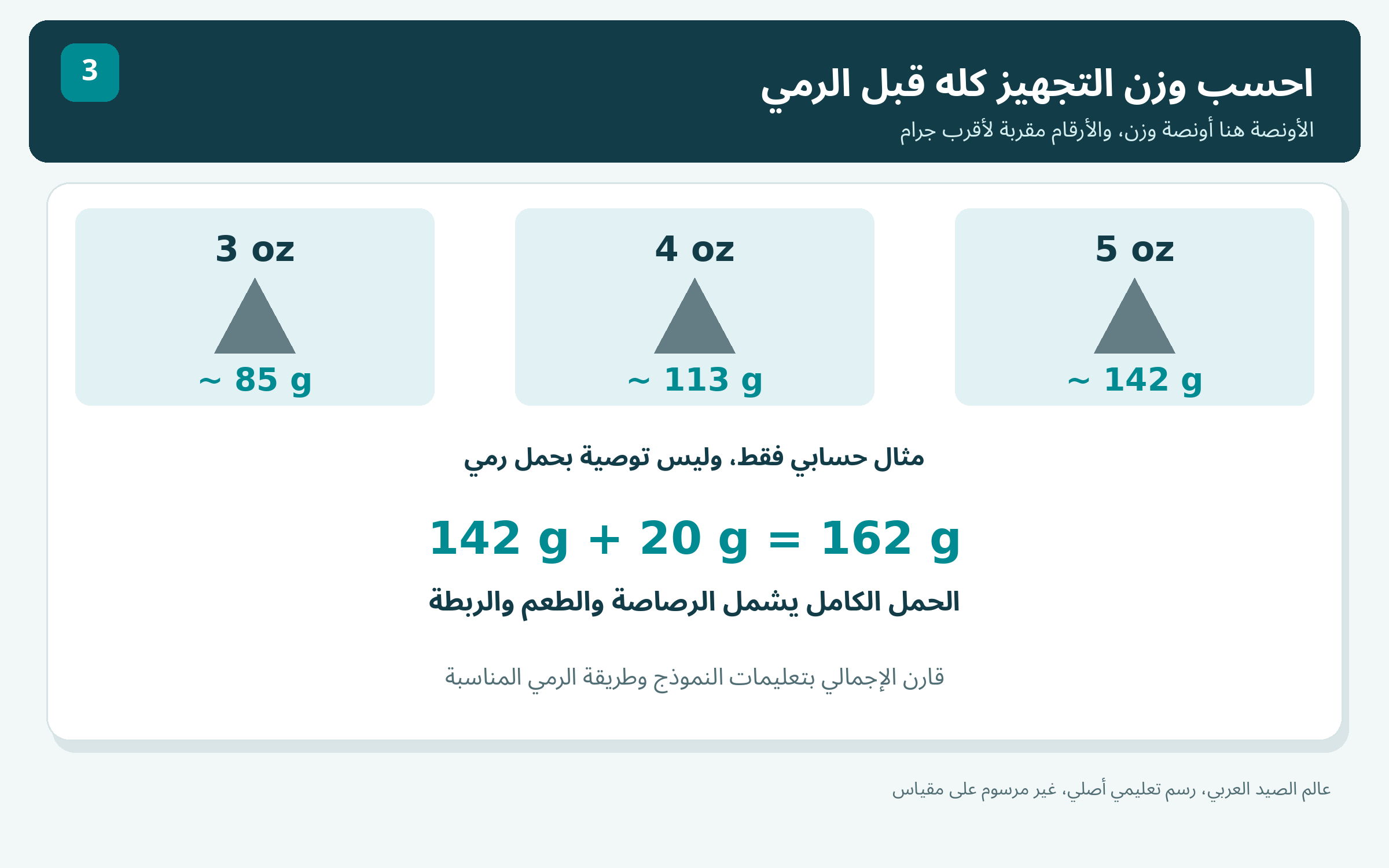
Add up the sinker, bait and rig together. A worked example only: a 5 oz sinker weighs about 142 g; if you add bait and rigging weighing 20 g, the total becomes about 162 g. This is not a recommendation for a particular weight, but it shows why looking at the sinker alone is not enough.
Similarly, 3 oz is about 85 g and 4 oz about 113 g. This is the common avoirdupois ounce used for fishing weights. Weigh your rig when in doubt, and leave the choice of load and casting method to the model's instructions and your real ability; do not test the maximum with a violent cast.
Action and power are different things
Action describes how the rod bends under load: where the bend starts and how it spreads. Power describes its resistance to bending. Shimano explains this distinction in its technical guide. [1]
Do not assume two rods are equivalent just because both say "fast", and do not conclude from a strong lower section that the tip cannot pick up light bites. Read the full model specification, and do not test stiffness by bending the tip by hand or lifting a hanging weight inside the shop.
Weight, balance and handle length
Grams matter, but so does where they sit. A rod of similar weight can feel heavier in motion if its mass is concentrated far from your hand. The handle length decides whether you can use your lower hand without hitting your body or forcing your shoulder into an awkward movement.
The number of sections and the transport length also have practical value: an excellent rod you cannot carry easily may not be the best for your trips. And telescopic and three-piece rods are not one level of quality; compare the actual models, guides and joints, not just the name of the construction.
8. What do manufacturers' specs say? An example of why you must compare
In the Daiwa Seahunter X Surf series, the company lists 3.90, 4.20 and 4.50 m with a single casting range of 100–250 g, while the published weights change to 455, 525 and 610 g respectively. This is an example from one specific series, not a rule for all products, and not a test we ran on the water. [2]
The point is that length, casting rating and weight are three separate pieces of data you need to read. In another Shimano series there are Beastmaster GX Surf Tele models of the same 4.20 m length but with different casting ratings of 150, 170 and 200 g. So it is not enough to tell the seller "give me a 4.20". [3]
These are teaching examples for reading specifications, not a buying recommendation or a price comparison. Check the model code and current specifications, as markets and production years may differ.
9. Applying it to Alexandria and Mediterranean beaches
On an open sandy beach, start by deciding where you want the bait to land: a channel edge, a depth transition, or the side of a sand spit. If it is within range of a rod you can control, do not look for extra length just to reach further water.
When waves keep breaking close in and affect the line, first review the holder position, rod angle, line arc and a suitable sinker shape. If the need for a higher tip remains clear, the extra length may become a testable advantage. Fishing from rocks or near a high edge also requires thinking about how you will land the fish, not just the cast.
When the sea is calm, use the ease of observation to try more than one distance. Do not assume that clear water always means the fish are far out, or that high surf guarantees better activity. The right distance is the one that serves the likely feeding zone, not the biggest number.
10. Does the same choice apply to Kuwait and the Gulf?
Yes, the same principles of load, balance and control apply, but your beach's needs decide the length, not the name of the sea. There is no specification that makes 4.20 automatically for the Mediterranean and 4.50 for the Gulf.
On a shallow sandy flat (saif), the water's edge may move with the tide, and with it the direction of the line and your best standing position. Follow the local forecast and the actual water movement; tip height alone will not fix a current that moves the sinker, nor guarantee the bait stays over a mixed rocky bottom.
In a creek (khor) or sheltered beach, you may not need the same advantage you need on an exposed beach. If the target zone is close, a rod that is easier to control can be enough. Boat fishing is a separate choice; do not buy a long surf rod as a solution for every kind of sea fishing.
When targeting sobaity or shaem, for example, bait presentation, rig and position still matter, and you cannot tie a species to a single length. Do not skip past a promising edge to a farther distance just because you are holding a longer rod.
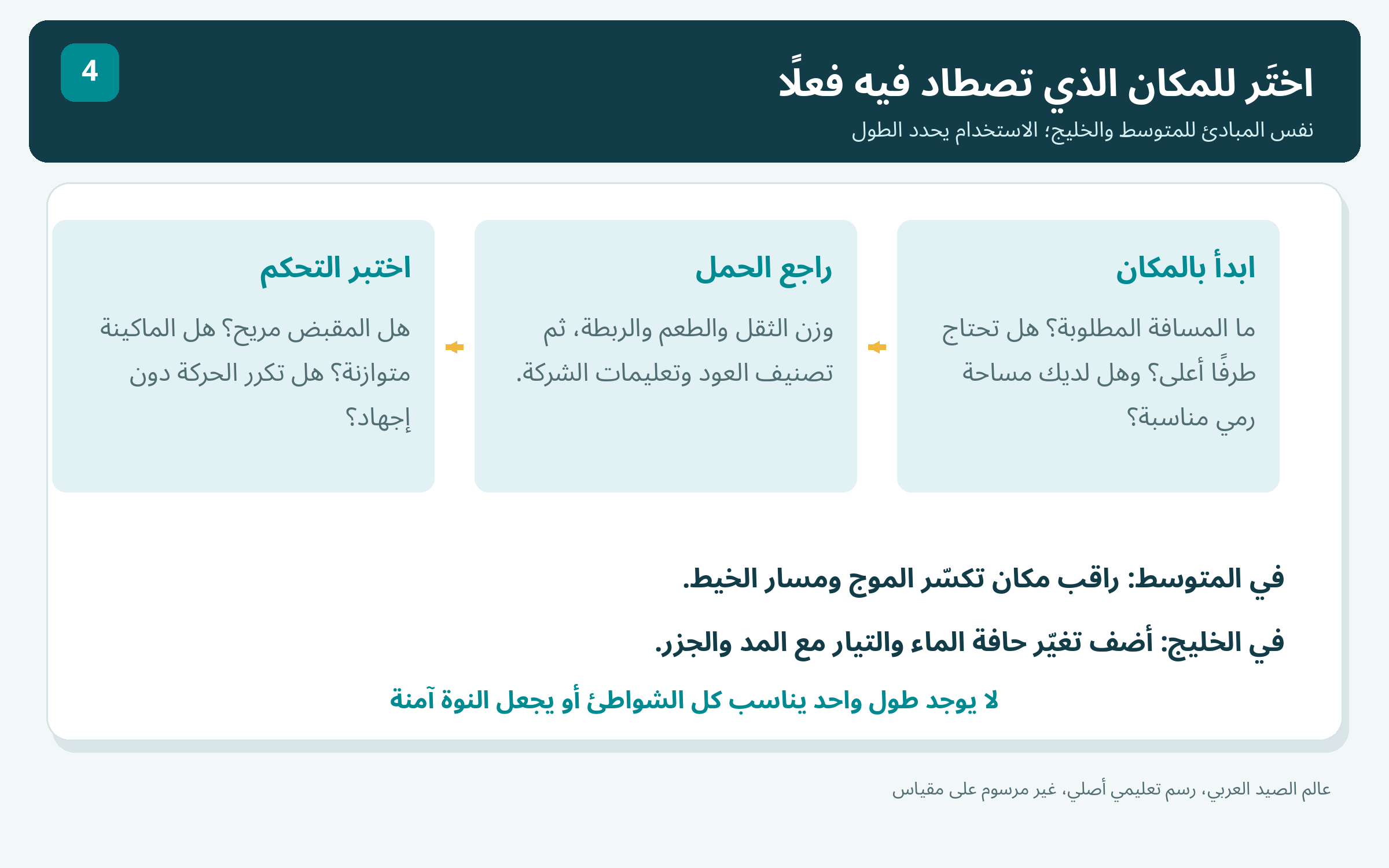
11. The buying test: seven minutes that can save you swapping rods
- Define your main use: bait and sinker from sand, from rocks, or a different method? State your usual place and conditions instead of asking for "the strongest rod".
- Write down your loads: the sinker weight you use, plus a realistic estimate for bait and rig. Compare the total with the model's instructions.
- Fit the reel with the seller's permission: hold the set-up in a natural carrying position and check it is secure and the grip is comfortable.
- Compare the handle: watch where your lower hand sits and its distance from your body, without simulating a cast inside a shop or near people.
- Check the data: model code, weight, rating, transport length, guides and joints, and care instructions.
- If possible, try it safely before buying: several casts in a suitable space under supervision, not a single cast at full power.
- Count the strain: can you repeat the movement with the same control? Any lasting pain or loss of balance is a reason to change the choice or the technique, not to use more force.
In heavy casting, you need a line, knot and protection system suited to the shock of the cast. Do not replace knowledge of a suitable shock leader with the printed strength of the main line alone. Safety guidance recommends paying attention to the casting path and the risk of the sinker coming loose, and staying away from power lines. [4]
Quick questions before you decide
I am a beginner: 3.90 or 4.20?
Try both models with a suitable load. If quality is similar and you find 3.90 more consistent and comfortable and it reaches your spot, it is an understandable choice. If you are comfortable with 4.20 and need extra length for working from the beach, there is nothing wrong with it. The start is not settled by the length number alone.
Does 4.50 m always cast further?
No. It may help when you benefit from its length, can handle the rod and release the rig with good timing. If it slows your movement or increases fatigue, the result may be the opposite. We do not promise a fixed distance for any length.
Does a longer rod stop the sinker from moving?
No. It may reduce how much of the line is exposed to nearby waves, but sinker movement depends on the bottom, current, its shape and weight, and line and wave resistance. Diagnose the cause of the movement before changing the rod.
I use 3 to 5 oz sinkers: is a 4.20 m rod enough?
Length does not answer that. Check the model's casting range, calculate the full load, and confirm the suitable casting method. You can find rods of the same length with completely different ratings.
Should I buy one rod for all conditions?
Choose what suits most of your realistic trips and accept its limits. No single length cancels out differences in bait, load, bottom and wind, and no tackle makes a dangerous day suitable for fishing.
The practical decision: try 3.90 when control and comfort are your priority, start from 4.20 for comparison if you have no special need, and try 4.50 when you can identify a real benefit from the extra length. The right rod is the one that delivers your bait to the target spot, with a suitable load and a cast you can repeat.
Sources and editorial notes
This is a general buying guide, not a field performance test or a promise of casting distance. The diagrams are original and educational; the example weights do not transfer automatically to other models. Check the manufacturer's instructions for the model you buy.
[1] Shimano: Rod action and power explained.
[2] Daiwa: Published specifications of the Seahunter X Surf series.
[3] Shimano: Beastmaster GX Surf Tele models and casting ratings.
[4] Angling Trust: Sea angling safety guidelines, and health and safety notes on casting-weight hazards.