

Shore fishing terms: how to read the sea and understand line and fish movement
You are standing on the beach next to an old angler, and you hear him say: "The sea is kashif, widen your cast a bit… and if the fish is mushammasha, give it a little slack." You may understand every word on its own, but you do not know exactly what is being asked of you: cast further? change the sinker? or open the bail and let the line move?
Anglers' language packs a whole situation into one word. The difficulty is not hard names, but that the same term can change from one beach to another, and that advice that was right in one specific moment turns, over time, into rules applied to every sea.
This guide explains a set of expressions used by anglers on the beaches of Alexandria and the Mediterranean, then turns them into practical steps a beginner can follow. At the end we see how to use them in Kuwait and the Gulf, allowing for different beaches, water movement and target species.
The core idea: do not look only for a name for the sea's condition; ask what is happening to the bait and line, and what small adjustment you can test.
1. A sea that is "zayt", "murih" or "shamshakha": what are you looking at?
"Zayt" (oil), "'adl" (even) or "murih" (comfortable) sea
Many anglers use these to mean the sea surface is calm, or the surf is weak enough to fish comfortably. The picture is familiar: a nearly flat surface, and a rod that is not pulled steadily and hard by each wave.
But there is a difference between a sea that is comfortable for the angler and conditions that suit the fish. The weather may be comfortable while the water is very clear, the current weak where you stand, or the bait is not passing through an active feeding zone. Water can also move below the surface even when the scene looks calm.
Use the calm to observe the spot and try more than one distance. Do not treat it as a promise of fish, and do not conclude from it that the bottom is free of rocks or that entering the water is safe.
"Shamshakhat al-bahr" (a stirring sea)
This word is used locally to describe a light swell or small movement that turns the water over near the shore. You may hear the word pronounced differently; what matters here is the condition the angler is describing, not a single scientific name.
Water movement can reveal or carry small food in the sand, so the edge where waves break deserves attention. But more surf is not a continuous improvement; if the bait no longer holds still, the line fills with weed, or the sea's signals mix with the fish's signals, you have a new problem that needs an adjustment.
A sea that has started to "settle" after a storm
A sea that begins to calm after a disturbance has several local names. The important thing is not to reduce the idea to "go down a day after the storm" or "wait two days"; these are not fixed periods that suit every case.
The wind may drop while swell from another area remains, and disturbance may last longer on an exposed beach than in a small nearby bay. Check the sea forecast, then compare it with what you see: is the swell dropping? Is its direction steady? Can you stand and fish from a suitable place?
2. A "kashif" sea: do you have to cast far?
When an angler says the sea is kashif ("revealing"), he may mean the water is clear, or the beach is exposed and offers no obvious cover for bait and fish. Here comes the usual advice: "Widen the cast; the fish is further out."
Sometimes the longer cast works, but it is not the only answer. Some fish move near a rock edge, a trough right next to the beach, or an area of shade and cover, even when the water is clear.
Instead of choosing the maximum distance from the start, divide the area in front of you into three test distances: near, medium and a farther one you can reach with control. Try them in turn with the same bait where possible. If the bites come at the medium distance, there is no reason the longer cast should be better just because it is longer.
Widen the cast means increasing distance. Change the casting angle means aiming in another direction. Tell them apart so you know which adjustment produced the result.
3. The back, the pool and the drop-off: where to put the bait
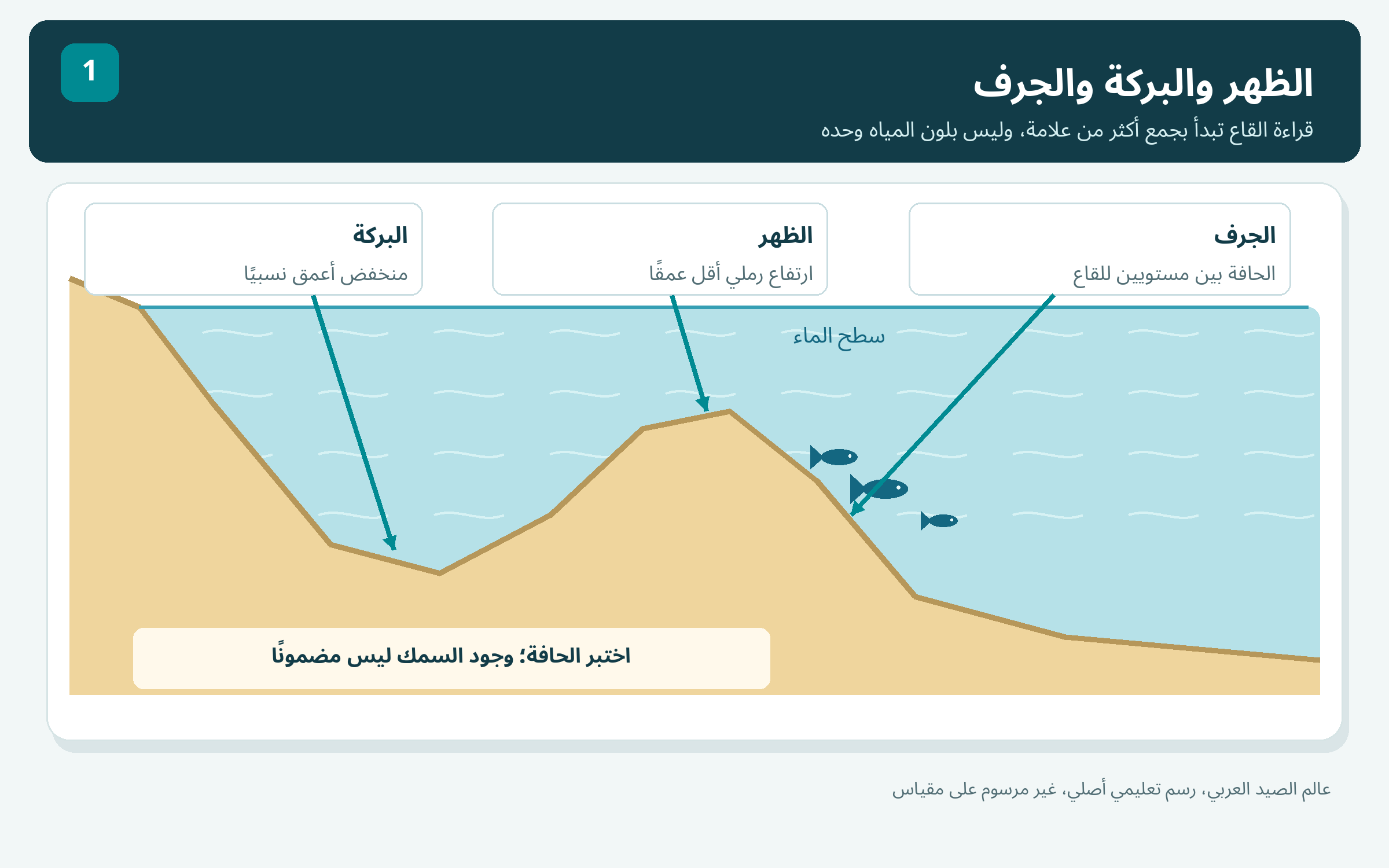
The back (al-zahr)
On a sandy beach the angler may mean a sand rise, or a part shallower than its surroundings. Sometimes waves break over this part before others, producing a band of white foam.
The pool (al-birka)
In this use the pool is not a separate pond of water, but a depression or a relatively deeper channel between higher parts of the bottom. It differs from the small pools left on the sand after the water recedes.
The drop-off (al-jurf)
The drop-off is the edge where the bottom level changes. The transition may be gradual or sharp, and this edge can be a path worth trying because water movement and food change around it.
We do not need to assume the fish are "always standing at the drop-off". We treat it as a possible search point, then test it instead of treating it as a guaranteed spot.
How do you read these signs from the shore?
Watch where a wave breaks and where it passes without clearly breaking, and whether that repeats in the same place. Notice colour differences, but do not rely on colour alone; cloud shadow, weed and bottom colour can make water look dark without it being deeper.
Likewise, the curve of the sand line on the beach gives you an idea worth checking, but it is not a confirmed map of what is underwater. Holes and sand tongues can change after strong surf, or as the water level changes.
One important note: a calm gap between two areas where waves break may be linked to a rip current pulling away from the beach. Read this sign from dry land; do not go into the channel to explore it or to retrieve a sinker. Apparent calm does not necessarily mean the absence of strong water movement. [1]
4. Sea wind and land wind: wind direction is not current direction
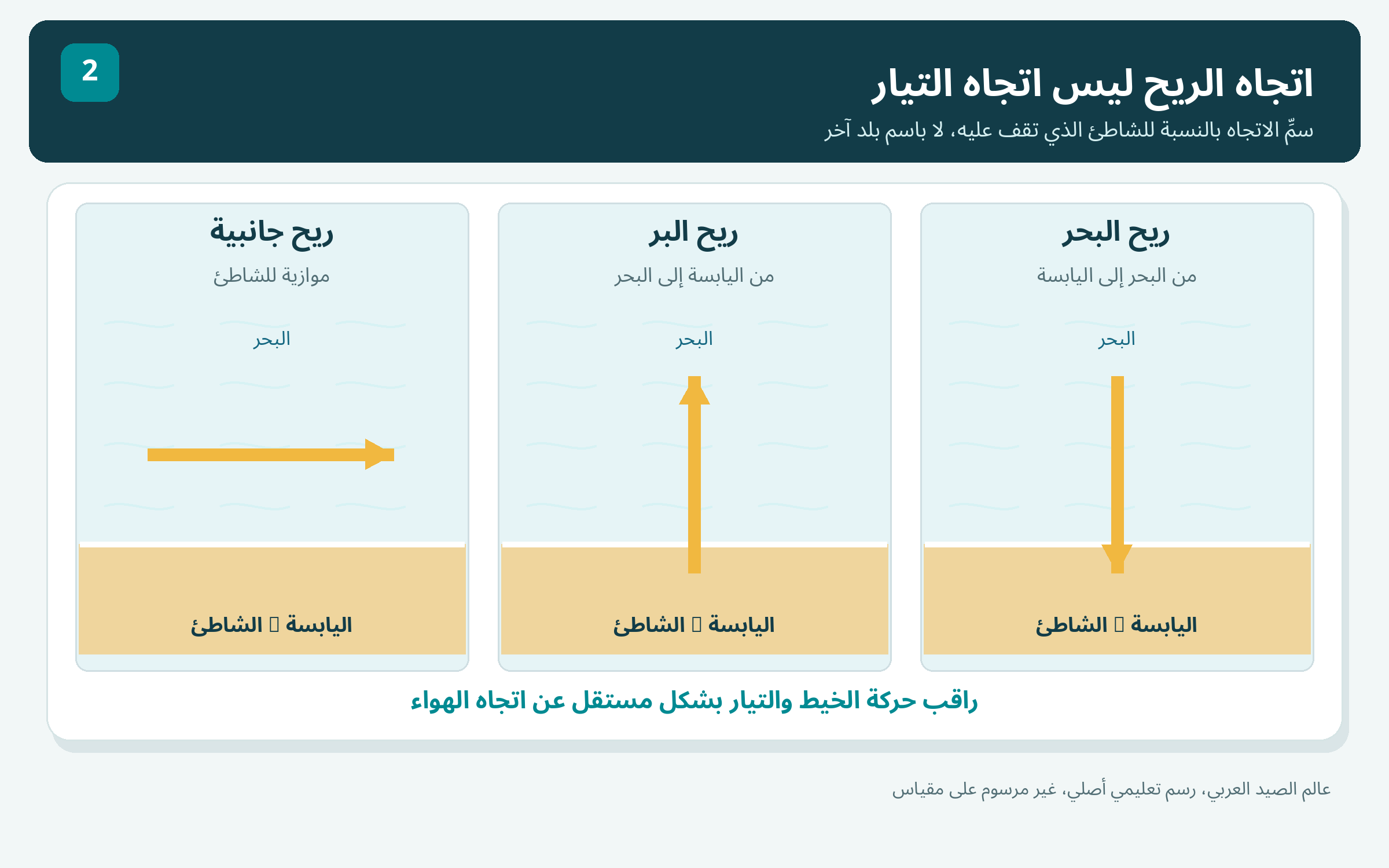
Sea wind (onshore)
The wind coming from the sea towards land. It may make casting into it harder, form an arc in the line, and contribute to a choppy surface. But its real effect depends on its strength, how long it lasts, the swell direction and the shape of the coast.
Land wind (offshore)
The wind blowing from land out to sea. It may make the water near you look calmer, but it does not guarantee a calm sea far from the coast, and it does not automatically make going into the water or out in a boat a suitable decision. [2]
Cross wind
It pushes on the line from the side, so you find you cast straight ahead while the line makes an arc to the right or left. If the current is also sideways, holding the rig still may get twice as hard, or the line may move differently from what you expected.
Current may arise from tides, or from the effect of wind and waves, and the terrain of the place shapes it. So there is no general rule that says "always sit against the wind and you will find fish there". Choose a position that lets you control the cast and line, then watch where the bait actually moves. [3]
In Alexandria the name of a wind may be tied to a geographic direction that anglers are used to on a particular beach. In the Gulf, do not carry that name over as it is; look at the direction of the coastline you are standing on, and decide whether the wind is coming in from the sea, going out from the land, or running parallel to the beach.
5. "The sea is running" and "the current is pulling": how to tell the sinker is moving
You might say: "I cast straight ahead, and a few minutes later the line was on the right." That alone does not prove the sinker slid; the line's arc above or in the water may have changed while the weight stayed close to its place.
To diagnose, watch several signs together: does the direction keep changing? Does the line move towards rocks or towards other anglers' lines? Does the rig come back from a different area again and again?
Start by reducing the extra line you do not need, and review your casting angle and the rod holder height. Then test a more suitable sinker in shape or weight, if that is within the limits of your tackle. Do not increase the lead automatically; adding load beyond the rod's rating is not a fix for a current problem.
Most importantly, the permitted casting weight relates to the full load of sinker, bait and rig, not the sinker alone. If conditions stay stronger than you can control, the sensible change may be changing position or postponing the attempt, not adding weight again.
6. "Gathering the slack" and "giving line": two different actions
What does "bush" mean?
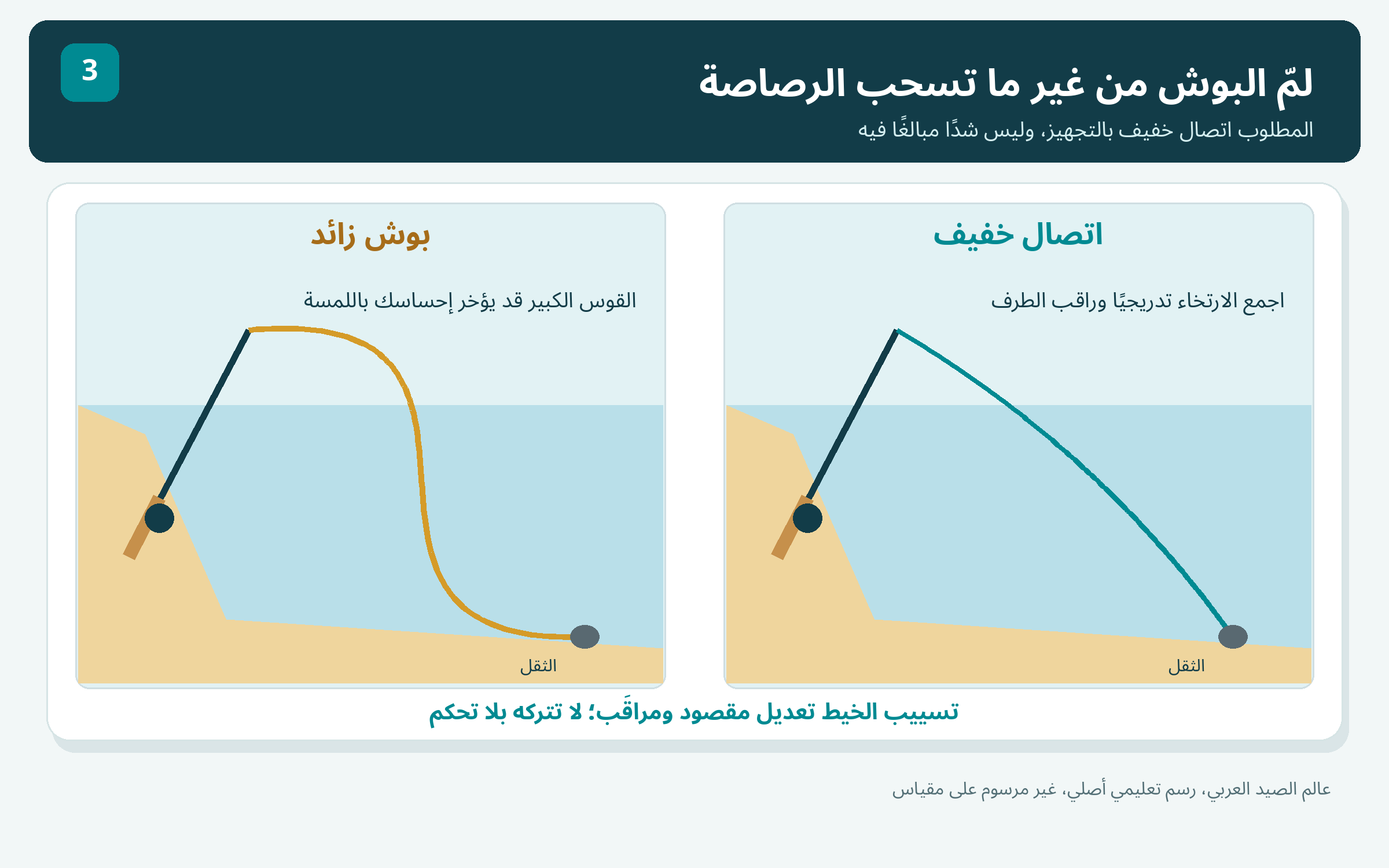
Bush (slack) is the loose or extra part of the line that separates you from a clear feel of the rig. It may show up as a big arc, or as a line that gives the rod tip no noticeable tension.
Gathering the slack means taking up this extra so your contact with the bait or sinker is clearer, without dragging the rig from its place every time.
Do not tighten the line like a musical string. Start with a light touch that lets you see change at the tip, then adjust to the surf and the fishing method. Tightening too much can move the sinker, change bait presentation, or make the fish feel early resistance.
And what does "giving line" mean?
It means deliberately giving a measured amount of line while watching, not opening the reel and leaving it uncontrolled. It may be used with a rig that lets the bait move, or to reduce resistance a fish meets as it takes the bait, or as part of a particular fishing method.
But giving more line can leave a branch wrapping around the sinker, or let the rig run into rocks. So when you hear the advice "give it line", ask: how much? with what rig? and is the sinker even holding?
Mastering fishing does not mean always tightening or always loosening the line; it means knowing why you adjust and watching the effect.
7. A fish that "eats gently" or is "mushammasha": read its behaviour, do not rush
These are popular expressions describing a fish that touches the bait cautiously, nibbles its edges, or does not take it with confidence. Their pronunciation and exact meaning may differ between groups of anglers.
But not every weak touch is evidence of a big, cautious fish. You may be facing small fish, a long bait that extends well past the hook, wave movement, or weed brushing the line.
Start by checking what comes back. Is the bait missing only at its tip? Is the hook point covered? Is the bait still intact? Did the signal repeat out of rhythm with the surf?
Try one adjustment: a smaller piece of bait, re-hooking it, or a hook size better suited to the target. Do not change bait, hook, distance and sinker at the same moment, or you will not know what made the difference.
"Answer the fish" and "finish it"
These usually mean handling the fish's take until the hook sets. Here you must distinguish between two hook shapes:
- The traditional J hook: you may need a measured lift after a proper take appears, allowing for the type of rig and line. Do not treat every nibble with a violent strike.
- The circle hook: the usual method is to take up the slack and increase tension gradually while reeling, not a violent strike to set the hook the same way. [4]
Choosing hook size is tied to the fish's mouth, the bait and the way it is presented, not just to the wish to catch a big fish.
8. "Hajjur", "jarraya" and "tawa'ir": what is the bottom telling you?
Hajjur
Some anglers use it for a spot close to rocks or edges where fish hide. Treat the word as a hint of cover or terrain worth checking, not as a uniform description of one kind of bottom.
Jarraya or farqa
It may refer to an area where the bottom changes from sand to stone, or where sand is mixed with rocks and weed. This transition can provide food paths and cover, but it also raises the chance of snagging the hook or sinker.
Tawa'ir (snagging)
It means the rig going into a spot where it snags: a crack, an edge, or closely spaced rocks. If snagging keeps happening at the same corner, that is information about the rig's path, not an invitation to pull harder.
Try changing the casting angle, or drawing the rig through a lower-friction path if possible, and check the leader after it comes back. A scratch is an important sign even if the line has not yet broken. And if the tackle snags, do not wrap the line around your hand or body to try to free it.
You can follow the companion guide: Snagging on rocks? Diagnose the problem before changing tackle
9. "Al-sala" and "sibhat tirmil": do not be fooled by the name
Local names such as "al-sala" are used to describe a bait rig without a sinker in some fishing methods, or with small movements that help present the bait. That does not mean every sinker-free rig carries the same name in all regions, or that it suits every depth and current.
As for "sibhat tirmil" (a "rosary" rig), some anglers mean a rig with several hooks. It is not an automatic recommendation to add more; every extra hook increases the chance of tangles and of difficult handling of the fish.
For a beginner, a simple rig you can understand and check is better for learning than a complex one where you cannot tell which part is causing the problem. Understand the function of the sinker, leader, branch and hook first, and follow the rules posted at the fishing spot.
10. Does this experience work in Kuwait and the Gulf?
Yes, the way of thinking and observing works, but do not carry over timing, names and results word for word.
Reading bottom transitions, watching the line's arc, and checking the bait after touches are all useful skills on a sandy beach in the Mediterranean or the Gulf. The differences show up in water level movement and current, the nature of the bottom, the target species, and how exposed the beach is to surf.
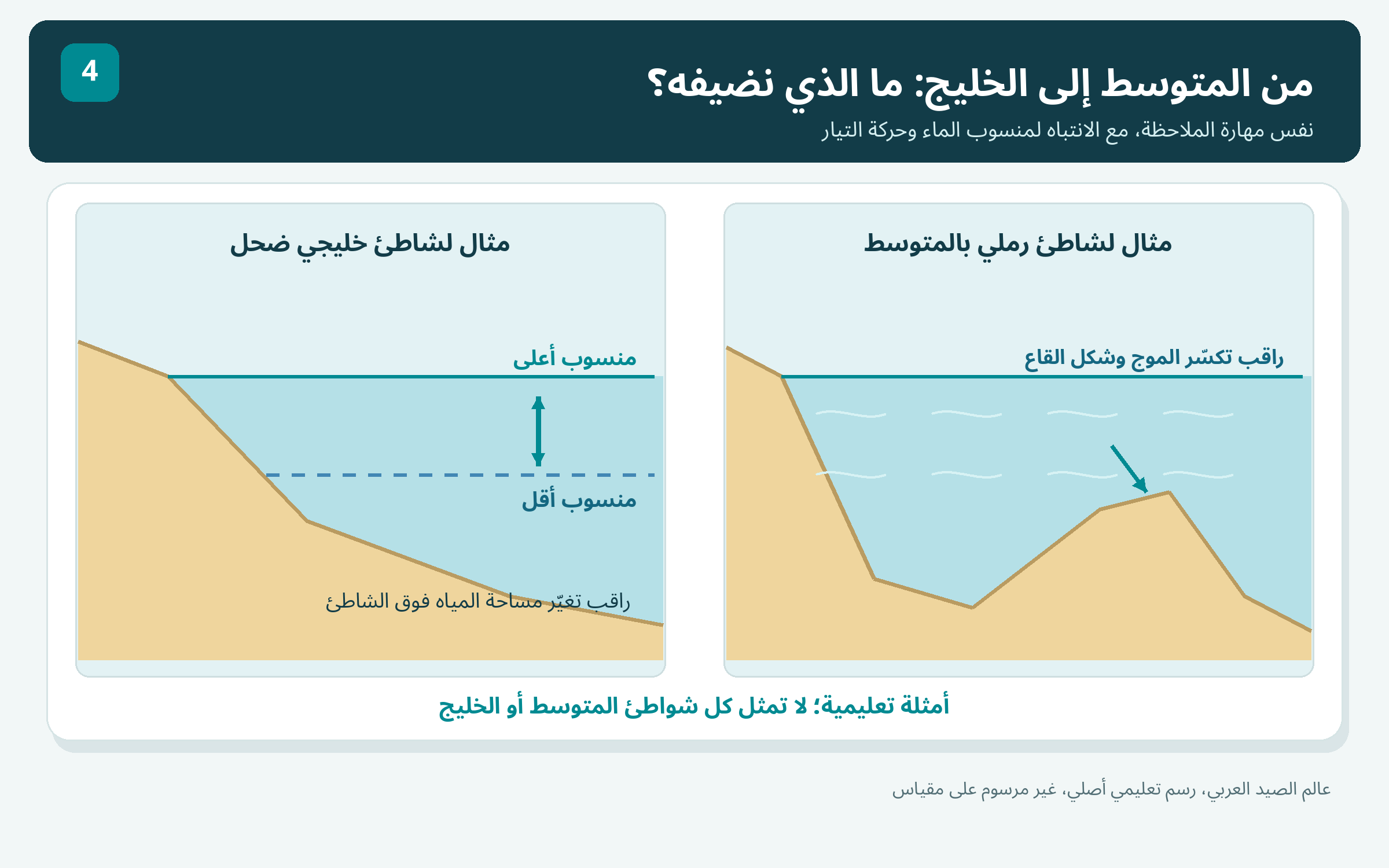
Add the tide to your beach reading
On many Mediterranean beaches the difference in water level is less noticeable than what an angler sees in some Gulf areas, but the Mediterranean is not one case; the Gulf of Gabès is a well-known example of a clearer tide, so it is wrong to say the Mediterranean has no tides. [5]
In Kuwait, check the table for the right coastal location, and do not assume the time of high water at a port is the same at every beach. The Kuwait Meteorological Department's official site combines sea forecasts with tide forecast options for specific ports. [6]
Also, the highest water level does not automatically mean the strongest current, and the time the current changes direction does not necessarily match the time of the highest or lowest level at every spot. Do not replace watching the line's movement with reading a single number in the table. [3]
Do not carry "widen the cast" over to every saif
On some shallow Gulf beaches the fish's access to the edge may change as the water level changes, so an area closer to the beach may be worth trying at one time and another distance at a different time. This is a testing method, not a promise that fish always come in with the tide.
And if you are targeting sobaity, for example, review bait presentation, quietness of movement and rig size before settling for more distance. If you target another species with another method, you may need a completely different set-up. The country name alone does not decide the rig or the time of the bite.
Wind is not judged by its name alone
The same wind may hit one beach head-on and run sideways on another. So tie the direction to the coastline in front of you, then check the actual state of the surf. And do not turn the name of a wind known in Alexandria into a fixed fishing time in Kuwait, Qatar or the UAE.
11. Practical application: the first half hour on the beach
Before putting on bait: stand for a few minutes in a suitable place and watch the wave cycles, the direction foam or weed moves, and visible obstacles. The aim is to collect signs, not to guess a full map of the bottom.
On the first cast: choose a clear mark you can repeat the direction towards, and use a distance you control. Once the rig settles, gather the slack gradually and watch whether the line holds or keeps moving.
At the first touches: compare them with the rhythm of the surf. If they repeat without a clear take, check the bait before increasing the strength of your response or changing all the tackle.
On the next attempt: test one variable only: distance, angle, bait size, or a suitable sinker shape. This way every cast becomes a useful comparison, even if no fish comes out.
Before moving: write a short note: the likely bottom shape, wind direction relative to the beach, line movement, and the state of the bait. In the Gulf add the tide stage and the current you saw; these notes are more useful than writing only "the sea was nice".
Questions beginners keep asking
Is a "zayt" sea better than one with a light surf?
Not always. Calm helps you control and observe, and a light surf may stir up food, but the verdict depends on the place, the target and your ability to keep the bait in the right spot.
Do I always need to cast beyond the last wave?
No. Look for differences in the bottom or water movement, and try more than one distance. A long cast may skip past the area that deserved fishing.
Does every slack in the line mean the fish is coming towards me?
No. A fish may really be approaching, but a change in the surf, the sinker shifting or a change in the line's arc can produce the same sign. Gather slack with control and do not base a decision on a single sign.
Should I rely on the curve of the sand to find the pool?
Use it as an initial clue together with repeated wave breaking and bottom differences, not as a depth measurement. Some details remain unknown from the shore however experienced you are.
What is the first skill to focus on?
Knowing why you are changing something in your rig. When you say "I reduced the slack to watch the touch" or "I changed the angle because the sinker is going into the rocks", you have started reading the situation instead of repeating the same cast.
The angler who improves is not necessarily the one with the longest cast, but the one who can turn what he sees into a clear question, then into a small experiment whose result he understands.
Sources and review
The terms here explain common local usage and are not a single dictionary. The images are original teaching diagrams and do not represent measurements of any bottom or fishing spot. The practical notes are suggestions to test, not a guarantee of fish or a verdict on the sea on a given day.
[1] NOAA / National Weather Service: Reading gaps between sandbars and rip currents.
[2] Met Office: Beach forecast, wind direction and surf explained.
[3] NOAA: The difference between tides and currents, and Tides FAQ and current timing.
[4] Florida Fish and Wildlife Conservation Commission: Fishing basics and the difference in handling circle hooks.
[5] Ocean Science, a study on tidal effects in the Gulf of Gabès.
[6] Kuwait Meteorological Department: Sea and tide forecasts.