

Casting and jigging: the difference and how to do each, for beginners
Casting and jigging are the two best-known ways of fishing with lures, and among the most enjoyable because you feel every movement and control the lure by hand. The idea is simple: instead of waiting for a fish to find a still bait, you move an artificial lure that looks like a wounded small fish, and predators attack it. This article explains the difference between the two methods, the tackle for each, the basic moves and the common beginner mistakes. The information is general and suits beginners; details change with place and species.
What is casting?
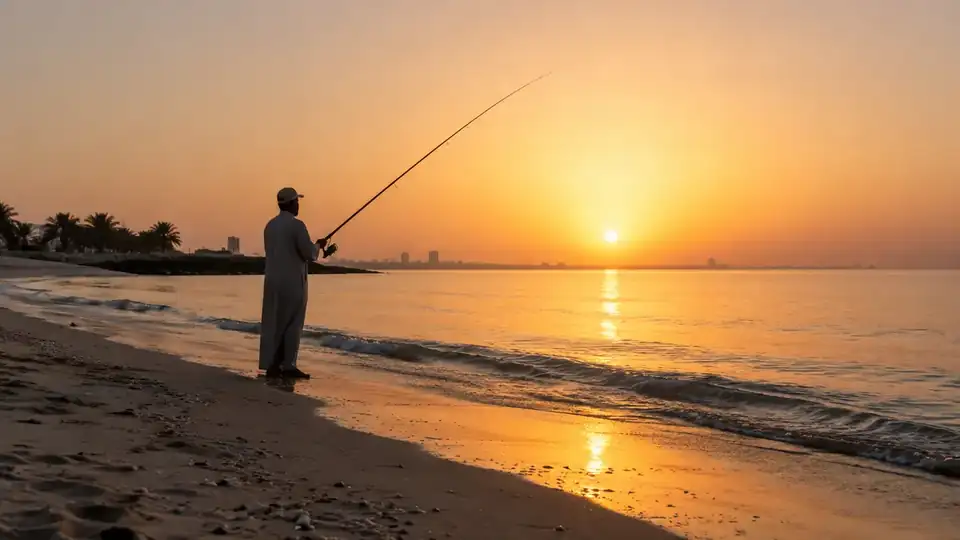
Casting means throwing a lure a long way and then retrieving it through the water, either steadily or in stops and starts. It is done from beach, rocks, pier and boat, and it targets predators that move near the surface or mid-water such as kingfish, grunter, trevally (GT), barracuda and sometimes rabbitfish, depending on region and season. Its strengths are that it covers a lot of water and lets you try many spots in a short time.
Lure types for casting
| Lure | What it is | When to use |
|---|---|---|
| Metal spoon / metal lure | A flashing, wobbling piece of metal | Long casts and fast retrieves for predators near the surface |
| Popper | Floating lure with a cupped head that splashes and pops | On the surface at dawn and dusk |
| Stickbait | Long lure that walks in a zigzag | For trevally and kingfish in open water |
| Diving minnow / plug | Fish-shaped lure with a lip that dives to a set depth | Steady retrieve near rocks and edges |
| Soft plastic | Rubber lure with a moving tail on a lead head | Slow retrieve near the bottom for hamour and sobaity |
How to cast
- Stance: feet shoulder-width apart, hold the rod with both hands: the stronger hand near the reel, the other at the end of the handle.
- Setup: let the lure hang about 20–30 cm from the rod tip, open the bail arm and pin the line against the rod with your index finger.
- The cast: bring the rod back over your shoulder, then push forward in one smooth motion and release the line when the rod is at roughly 45 degrees.
- Close the bail: close it once the lure lands, then start the retrieve.
- Look behind you: always check behind before casting so the hooks do not hit anyone; this is the most important safety rule in casting.
Retrieves
- Steady retrieve: constant speed, suited to plugs and spoons.
- Stop & go: reel, then pause a second; many bites come on the pause.
- Twitching: short wrist flicks to make a stickbait walk in a zigzag.
- Fast retrieve: for kingfish and barracuda, which like a fast, darting lure.
What is jigging?
Jigging means lowering a heavy metal lure (the jig) vertically to the bottom or to a chosen depth and then working it up and down in a way that tempts predators lying deep. It is mostly done from a boat, and sometimes from shore that drops off quickly or from piers. It targets hamour, grunter, kingfish, tuna, large trevally and reef fish depending on the region, and jigs range from about 20 grams to over 200 grams depending on depth and current.
Types of jigging
- Slow pitch jigging: uses a flexible rod and gentle motion so the jig "dances"; excellent for cautious fish.
- Speed jigging: very fast, continuous retrieval, suited to active fish such as tuna and kingfish.
- Light shore jigging: small jigs cast far and worked with short motions near the bottom.
The basic vertical jigging motion
- Drop the jig to the bottom and close the bail as soon as the line goes slack.
- Raise the rod tip quickly about 60–90 cm, then lower it while reeling in the slack.
- Repeat at a steady rhythm while lifting the jig gradually 5–10 metres above the bottom.
- If there is no bite, drop to the bottom again and repeat.
- On a bite, lift hard to set the hook and keep reeling.
Suitable tackle
| Item | Casting | Jigging |
|---|---|---|
| Rod | 2.4–3 m, medium to heavy power, fast tip | Shorter (1.6–2.1 m), stronger, flex depends on style |
| Reel | Spinning 4000–6000 with a good retrieve ratio | Strong spinning or overhead with higher drag |
| Main line | PE size 1.5–3 | PE size 2–5 depending on fish |
| Leader | Fluorocarbon 0.40–0.60 mm (about 30–60 lb) | Stronger fluorocarbon to protect against teeth |
| Accessories | Swivels, split rings, pliers | The same, plus assist hooks |
These figures are approximate and only a starting point. Ask at the tackle shop for the right kit for your fish and place, and start with a medium setup that does not tire you out.
Important knots
PE main line is slippery, so it is joined to the leader with a suitable knot such as the FG or the Albright, which is easiest for beginners; the lure is then tied on with a loop knot (such as the Rapala loop) or an easy loop that gives it free movement. Practise the knots at home before the trip.
Best times
Predators are usually active at dawn and dusk and when water is moving. So combine lure fishing with the ebb and flood windows in the tool, and watch the wind: strong wind makes casting hard and raises the risk. See the best time to fish and reading the weather before you go.
Beginner mistakes
- Casting without looking behind; the hooks can injure someone nearby.
- Retrieving at one speed all the time; vary the speed and rhythm.
- Careless drag setting: too tight breaks the line, too loose loses the fish.
- Skipping the leader and relying on the main line alone near rocks.
- Letting a jig fall uncontrolled onto rocky bottom, where it snags. See avoiding snags on rocky bottom.
Safety
Treble hooks on lures are sharp and can easily injure a hand; use pliers to unhook fish and carry scissors for the line, sunglasses to protect your eyes, and a glove for handling big fish. For more, read fishing rules and safety, and for baits suited to your country see Gulf baits and Egypt baits.